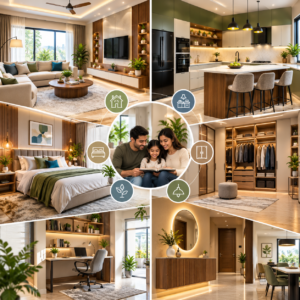
A beautiful home should do more than impress visitors. It should make mornings easier, keep everyday belongings organized, provide comfortable spaces to relax and support the way your family actually lives. This is where Lifestyle-Centred Home Interiors become valuable. Instead of starting with a trend or a furniture catalogue, this approach starts with your routines, preferences, available space and practical requirements.
1. Start With How You Live
Every family uses a home differently. Some spend most evenings together in the living room, while others need a quiet work corner. Families with children may need durable finishes and accessible storage, while people who entertain frequently may want generous seating and an open layout.
Lifestyle-Centred Home Interiors begin by understanding these habits. Before selecting colours or furniture, consider who uses each room, what activities happen there and what currently feels inconvenient.
2. Plan Every Room Around Its Purpose
A room can look attractive and still be difficult to use. A sofa that blocks movement, a wardrobe with insufficient storage or a kitchen without enough working space can quickly become frustrating.
With Lifestyle-Centred Home Interiors, each area is planned around its primary purpose. The living room can balance seating and movement, the bedroom can prioritize rest and storage, and the kitchen can support an efficient cooking routine.
3. Make Storage Part of the Design
Storage should not feel like an afterthought. Poorly planned cabinets can make rooms look crowded, while insufficient storage can lead to everyday clutter.
Lifestyle-Centred Home Interiors integrate storage into the overall design. Built-in wardrobes, loft cabinets, concealed drawers, TV-unit storage and customized kitchen organizers can help keep frequently used items accessible while maintaining a clean appearance.
4. Choose Furniture for Comfort and Proportion
Furniture should fit both the room and the people using it. An oversized sofa may look impressive in a showroom but can make a compact apartment feel cramped.
Lifestyle-Centred Home Interiors focus on proportion, circulation and comfort. Measure the room before purchasing furniture and leave enough space for doors, walking paths and daily movement. This simple planning step can make a noticeable difference.
5. Use Lighting for Different Activities
One light source rarely works perfectly for every activity. Your living room may need soft ambient lighting, while a kitchen requires brighter task lighting. Bedrooms often benefit from warm, relaxing illumination.
Lifestyle-Centred Home Interiors use layered lighting to support different moments of the day. Ceiling lights, cove lighting, pendant fixtures, wall lights and focused task lighting can work together without making the space visually complicated.
6. Select Materials That Match Your Routine
Material selection should consider more than appearance. Think about maintenance, durability, cleaning requirements, moisture exposure and how frequently a surface will be used.
For busy households, practical finishes can be especially useful. Lifestyle-Centred Home Interiors balance visual appeal with materials that suit everyday living, helping homeowners avoid choices that look beautiful but become difficult to maintain.
7. Create a Connected Colour Palette
Different rooms can have their own character without looking disconnected. Choose a base palette that flows through the home and introduce individual accent colours where appropriate.
Neutral shades, natural wood tones and subtle greens or blues can create a calm foundation. Lifestyle-Centred Home Interiors use colour strategically so the home feels cohesive while still allowing each room to have its own identity.
8. Design for Future Needs
A home should not only work for today. Families change, work routines evolve and storage requirements can increase over time.
Lifestyle-Centred Home Interiors consider flexibility wherever possible. A spare room might function as a home office today and a child’s room later. Modular furniture, adaptable storage and practical layouts can make the home easier to adjust as life changes.
9. Bring Personality Into the Space
A professionally designed home should still feel personal. Artwork, family photographs, books, plants, travel memories and favourite décor can add character.
Lifestyle-Centred Home Interiors leave room for these personal elements rather than filling every surface with decoration. The result is a space that feels curated without becoming overly styled.
10. Think About the Details You Use Every Day
Small details often have a big impact on comfort. The position of switches, charging points, appliance locations, drawer heights and wardrobe sections can influence how smoothly a home functions.
Good Lifestyle-Centred Home Interiors pay attention to these everyday interactions. Planning them early can reduce future modifications and make the finished interior more convenient.
Why Professional Planning Makes a Difference
Interior design involves many connected decisions. Layout, electrical planning, lighting, storage, materials, furniture, colours and execution all need to work together.
Lifestyle-Centred Home Interiors provide a practical framework for bringing these elements together. A professional team can understand your requirements, develop suitable concepts, coordinate details and help turn an empty space into a functional home.
At GK Home Interiors, the focus is on creating interiors that combine thoughtful design with everyday usability. From modular kitchens and wardrobes to living rooms, bedrooms, TV units and complete turnkey solutions, every element can be planned around the homeowner’s requirements.
Build a Home Around Your Lifestyle
The most successful interiors are not necessarily the most expensive or the most fashionable. They are the ones that make everyday life easier while reflecting the personality of the people who live there.
Lifestyle-Centred Home Interiors can help you move away from simply copying designs and instead create a home that responds to your routines, storage needs, comfort preferences and future plans.
If you are planning a new home or renovating an existing one, begin by listing what works, what does not and what you want to improve. From there, thoughtful planning can turn your ideas into a space that feels natural, organized and genuinely yours.
GK Home Interiors helps homeowners create practical and elegant spaces designed around real lifestyles.
📞 97424 83054
🌐 gkhomeinteriors.in